
The HECM Reverse Mortgage Explained
How They Work, Who Qualifies & How Much You Can Borrow
Most people have heard of a Reverse Mortgage. But ask them what a HECM Reverse Mortgage is, and you’ll probably get a blank stare. And I can’t blame them. The mortgage industry has never been very good at making things easy to understand!
HECM stands for Home Equity Conversion Mortgage. It’s the FHA-insured Reverse Mortgage program available to homeowners age 62 and older, and it’s the most common type of Reverse Mortgage in the country.
Here’s the basic idea. You’ve spent years, maybe decades, paying down your mortgage and building equity in your home. A HECM allows you to turn a portion of that equity into money you can actually use during retirement, without having to sell your house or make required monthly principal and interest payments.
You can use the proceeds to pay off an existing mortgage, establish a line of credit, receive monthly payments, or simply give yourself a little more financial breathing room.
And you still own your home.
The bank doesn’t suddenly become your landlord, despite what some people seem to believe!
Now, there are responsibilities. You still need to continue to pay your property taxes, maintain homeowners insurance, keep the home in good condition, and live in it as your primary residence. And like any mortgage, there are costs and trade-offs worth understanding.
I’ve been helping homeowners and their families navigate HECM Reverse Mortgages since 2008, and I’ve seen firsthand what these loans can do for someone’s retirement. In addition, I’ve seen situations where a Reverse Mortgage simply wasn’t the right answer. My job is to help people understand the difference.
So let’s get into how a HECM works, who qualifies, how much money you can access, and what you should know before making a decision.
What is a HECM Reverse Mortgage?
A HECM Reverse Mortgage (Home Equity Conversion Mortgage) is a federally insured reverse mortgage designed for homeowners age 62 and older. It’s regulated by the Federal Housing Administration (FHA), which is part of the U.S. Department of Housing and Urban Development (HUD).
That’s a lot of government acronyms, I know. Fortunately, you don’t need to memorize any of them to understand how the program works!
The HECM allows you to borrow some of your home’s equity without having to make monthly principal and interest payments on the reverse mortgage. Instead, the interest and mortgage insurance charges are generally added to your outstanding loan balance over time.
Now, here’s where a lot of people get confused. A HECM is still a mortgage. You’re borrowing money against your home, just like you would with a traditional mortgage. The big difference is how and when that money gets paid back.
With a traditional mortgage, you make monthly payments to the lender, gradually reducing what you owe. But with a HECM, you’re generally not making those payments, so your loan balance typically increases over time. The loan usually becomes due when the last borrower dies, sells the home, or permanently moves out, subject to certain protections for eligible spouses(don’t worry…we’ll get into non-borrowing spouses towards the end of this article).
And here’s another important distinction: FHA doesn’t lend you the money. A private lender makes the loan, while FHA insures the HECM program. That insurance helps protect lenders against certain losses and supports important borrower protections.
One of those protections is that a HECM is a non-recourse loan.
In plain English, neither you nor your heirs can be held personally responsible for a shortfall if the loan balance eventually exceeds the home’s value. The lender can’t go after life insurance, the estate or any personal property. So your kids won’t one day wake up to an unpayable bill.
And no, the lender doesn’t own your house! You retain ownership, provided you continue meeting the loan requirements, including paying property taxes, maintaining homeowners insurance, keeping the property in good condition, and using it as your primary residence.
That’s the foundation of a HECM Reverse Mortgage. Next, let’s look at how the money actually works, because this is where things get fun.
How Does a HECM Reverse Mortgage Work?
Let’s say you’re 70 years old, you’ve owned your home for 25 years, and you’ve built up a pretty substantial amount of equity. That’s wonderful, but there’s just one little problem. You can’t exactly take your home equity to Publix and use it to buy groceries!
That’s where a HECM Reverse Mortgage comes into play.
Instead of selling your house to grab that equity, you can borrow against a portion of it while continuing to live in your home. How much you can access depends on several factors, including your age, your home’s value, current interest rates, and any existing mortgages.
Now, unlike a traditional mortgage, a HECM doesn’t require you to make monthly principal and interest payments. That’s a pretty significant difference, especially when you’re retired and trying to make your income stretch as far as possible.
Here’s how it typically works.
First, we pay off your existing mortgage, if you have one.
Let’s say you still owe $350,000 on your home. The HECM proceeds would first be used to pay off that loan. Your old monthly mortgage principal and interest payment disappears, and you replace it with a Reverse Mortgage that doesn’t force you into a life sentence of monthly principal and interest payments.
If you’re living on Social Security, a pension, or retirement savings, eliminating your monthly mortgage payment can make an enormous difference. That’s money you no longer have to pull out of your checking account every month.
Next, depending on how much equity is available, you may have additional money left over.
You could receive some of that money upfront, establish a line of credit, arrange monthly payments, or use a combination of these options, depending on the type of HECM you choose.
And here’s something people often overlook: You don’t have to take all the money you’re eligible for. With a variable-rate HECM, you can leave available funds in a line of credit and access them later when you actually need them. There are first-year withdrawal limits and other program rules, which we’ll explain further down the page.
By the way, if you don’t owe anything on your home, you can still get a HECM Reverse Mortgage. You’ll just get access to more cash because you aren’t paying anything off. Later on in this article we’ll go over the HECM Credit Line, which is incredibly powerful. I can’t wait to share it with you!
So far so good. But if you’re thinking critically about this, you’re probably asking yourself, “What’s the catch?”
Well, there isn’t a magical mortgage fairy paying your interest every month!
Because you’re generally not making monthly principal and interest payments, the interest and ongoing FHA mortgage insurance charges are added to your loan balance. If that’s the case, the amount you owe will increase over time.
The money is only paid back when the home is sold, the last borrower dies, or the property is no longer the borrower’s primary residence. At that time, your heirs will inherit it, and they will pay back what’s owed by selling or refinancing. Whatever cash is left over is theirs.
That’s the basic mechanics. Not nearly as complicated as the mortgage industry makes it sound, is it?
Real Client Story: How a HECM Reverse Mortgage
Helped Dave Get His Retirement Back
Let me tell you about my new friend Dave, a widower living in Wellington, Florida, whose retirement cash flow was an absolute mess.
Dave was living on Social Security, but the bills certainly weren’t taking it easy on him. He had a mortgage payment, credit card debt, a car payment, a substantial HOA fee, and homeowners insurance that, as anyone living in South Florida knows, isn’t exactly cheap!
His daughter-in-law was worried about him. She had three children of her own and wanted to help, but taking on Dave’s expenses would have put a serious strain on her family’s finances. After finding my Google reviews, she gave me a call to see whether there was anything we could do.
And fortunately, there was.
We put together a HECM Reverse Mortgage that allowed Dave to pay off his existing mortgage and access enough cash to eliminate his credit card balances and car loan.
Think about what that did for his monthly cash flow. No more required mortgage principal and interest payment, no more car payment, and no more credit card payments on the debts we paid off. That’s a pretty substantial change for someone living on Social Security!
But we weren’t finished.
We were also able to establish a HECM line of credit that Dave could use to help cover his HOA expenses going forward.
And here’s my favorite part of this story. Dave is happy, and his daughter-in-law can finally stop worrying about how she’s going to help him financially while raising her own family.
Sometimes a Reverse Mortgage doesn’t just change one person’s retirement. It takes an enormous weight off the shoulders of everyone who loves them.
That’s what makes this work so rewarding.
What Dave's Daughter-in-Law Had to Say

Who Qualifies for a HECM Reverse Mortgage?
Once people understand how it works, one of the first follow-up questions I get is, “Can I actually qualify for a HECM Reverse Mortgage?” And the good news is that qualifying is often easier than people expect, particularly compared with a traditional mortgage.
But there are some rules, and because we’re dealing with an FHA-insured program, we don’t get to make them up as we go along!
First, you need to be at least 62 years old.
That’s the minimum age for a HECM. Now, certain Proprietary Reverse Mortgages are available beginning at age 55, depending on the program and state, but those are different products. For the FHA-insured HECM program, 62 is the magic number. You can have a spouse who’s under 62, but if she lives with you we’ll go off her(or his) age, not yours. This is called an eligible non-borrowing spouse.
Second, you need sufficient equity in your home.
There’s no single equity percentage that guarantees approval. Your loan size depends on your age, the home’s value and current interest rates. If you still have a mortgage, that’s perfectly fine, provided the HECM proceeds are enough to pay it off at closing.
Third, the home needs to be your primary residence.
You can’t use a HECM on your vacation home or an investment property. Also, you need to occupy the property as your principal residence and continue to live there over the years. Note: if you are married and one spouse moves out or passes away, you’re fine. As long as one of you keeps your home as your primary you’re playing by the rules.
Fourth, the property itself must qualify.
Single-family homes, certain two-to-four-unit properties, FHA-approved condominiums, and some manufactured homes may be eligible. The property must also meet applicable FHA standards.
Condominiums deserve special attention because not every condo qualifies for an FHA HECM. As a backup, the Jumbo Reverse Mortgage generally has an easier condo approval process than HECMs.
Fifth, the FHA requires a financial assessment.
This is where we review your income, credit history, and ability to keep up with property taxes, homeowners insurance, and other required housing expenses.
Now, don’t panic if your credit isn’t perfect or you’re living primarily on Social Security. A HECM doesn’t have the same qualification requirements as a conventional mortgage. I’ve helped plenty of retirees whose financial situations wouldn’t fit neatly into a traditional lending box.
That said, lenders do need to determine whether you can reasonably meet your ongoing property obligations. In some situations, part of the available loan proceeds may need to be set aside to cover future taxes and insurance(this is called a LESA-or lifetime expectancy set-aside).
Finally, you’ll need to complete Reverse Mortgage Counseling with an independent HUD-approved counselor before the loan can move forward. It’s designed to make sure you understand the loan, your responsibilities, and the alternatives available to you. We’re happy to give you a list of counselors to reach out to when the time is right.
So while there are requirements, the process isn’t nearly as intimidating as some people imagine. And if you’re not sure whether your home, income, or equity qualifies, that’s exactly the kind of thing we can figure out together.
How Much Money Can You Get from a Reverse Mortgage?
This is usually the point in the conversation where someone interrupts me and says, “Okay Jason, this all sounds wonderful, but how much money can I actually get?”
Fair question! After all, that’s probably why you’re looking into a Reverse Mortgage in the first place.
Unfortunately, I can’t give you a percentage of your home’s value and call it a day. FHA has a formula for calculating how much equity you can access, and there are a few things that go into it.
Let’s start with your age. Generally speaking, the older you are, the more money you’ll qualify for. A 78-year-old homeowner will have access to about 12% more of their home’s value than someone who just turned 62. FHA bases this calculation on the age of the youngest borrower, not older.
Of course, the value of your home plays a big role as well. A senior with a $700,000 property will have way more borrowing power than one with a $300,000 property, assuming their ages and interest rates are identical.
But FHA does have a ceiling. Each year, HUD establishes a maximum home value that can be used when calculating HECM proceeds. In 2026, that number is $1,249,125. If your home is more valuable, you won’t be able to get any more money with a HECM Reverse Mortgage.
This is exactly what Jumbo Reverse Mortgages are built for.
Then we have interest rates, which can make a surprisingly big difference. Most people understand that rates affect how much interest they’ll accumulate on a loan, but with a HECM Reverse Mortgage, they also help determine how much equity you can initially access.
You can skip this paragraph if you don’t want to go into interest rate nerd mode, but HECMs are based on the 10 Year CMT. Every Tuesday, loan sizes can move up or down based on the CMT’s average over the previous week.
Generally, lower expected interest rates allow you to borrow more, while higher rates reduce the available proceeds. This is why accurate Reverse Mortgage Calculators are almost impossible to produce.
Qualifying for the Money and Actually Receiving It Are Two Different Things
Here’s where things get interesting, especially if you still have a mortgage.
Let’s say FHA’s calculations indicate you have $300,000 available through a HECM Reverse Mortgage. That’s your starting point, not necessarily the amount you’re going to receive in cash.
If you owe $175,000 on your existing mortgage, we have to pay that off first. What’s left is the amount you may be able to access through the payment options available under your loan.
Doing easy math, that’s $125,000. But I’m about to throw a wrench into things(sorry, but again this is FHA’s game).
FHA limits how much money you can take out during the first 12 months; and it’s typically 60% of the total loan size(or $300,000 in this case). BUT there’s a catch…and it’s a good one.
If you have a substantial mortgage to pay off, FHA allows you to cover that balance, your closing costs and take out another 10% of the original loan size.
And after the first year, you can take the remaining funds(only with a variable rate HECM, not with a Fixed).
If paying off that $175,000 mortgage eliminates a $1,500 monthly principal and interest payment, we’ve just freed up $18,000 a year in cash flow.
That’s $18,000 that no longer has to come out of your Social Security, pension, or retirement savings to make those payments. And depending on the numbers, you might still have additional funds available.
For someone trying to stretch their retirement income, that can make a tremendous difference.
Let’s Find Out What Your Home Can Actually Do for You
I could fill this page with charts and percentages, but those numbers would only tell part of the story. Your age, home value, mortgage balance, and current interest rates all need to be considered together.
I’ve been helping homeowners with reverse mortgages since 2008, and one of the things I’ve learned is that no two situations are exactly alike. Sometimes a HECM works beautifully. Other times, a Proprietary Reverse Mortgage might provide more money, or we discover that borrowing against the home isn’t the best solution.
I’d rather give you accurate numbers than have you make financial decisions based on some generic online calculator.
If you’d like to see what may be available to you, visit ReverseQuotes.com for a personalized Reverse Mortgage estimate. We’ll look at your situation, explain the options, and see whether the numbers make sense.
But we won’t guess.
Fixed vs Variable Rate HECM Reverse Mortgages
When it comes to HECM Reverse Mortgages, you have two interest rate options: fixed and variable. And while most people are naturally attracted to the idea of a fixed rate, there’s a pretty good reason I spend much more time discussing variable-rate HECMs with my clients.
A fixed-rate HECM can make sense if you have a substantial existing mortgage that needs to be paid off. But there are some significant drawbacks. Fixed-rate programs typically allow you to borrow less than their variable-rate counterparts, and you’re required to take your available proceeds in one lump sum at closing.
Here’s the bigger problem. FHA restricts how much you can initially withdraw, and with a fixed-rate HECM, you don’t get another opportunity to access the remaining equity through that loan. There’s no line of credit, no monthly payment option, and no flexibility to take additional funds down the road.
That’s why my clients overwhelmingly prefer the variable-rate HECM, which is based on the 10 Year CMT.
There are options with an interest rate cap of 5% and 10%. Not shockingly, my clients always choose the 5% interest rate cap.
Yes, the interest rate can change over time, but you have considerably more flexibility in how you receive your money. You can establish a line of credit, arrange monthly payments, take a lump sum, or combine these options to fit your retirement needs.
And here’s something many homeowners don’t realize: you don’t pay interest on money sitting unused in your HECM line of credit. Interest accrues on the outstanding loan balance, not on the funds you haven’t borrowed.
For someone who wants to eliminate an existing mortgage payment while keeping additional equity available for future expenses, that flexibility can be incredibly valuable.
In fact, the line of credit is one of my favorite features of a HECM Reverse Mortgage, and it deserves a closer look.
The HECM Line of Credit: One of Retirement's Best Kept Secrets
I’ve been helping seniors with Reverse Mortgages since 2008, and one of my favorite features of the entire HECM program is the line of credit. It’s also one of the most misunderstood.
Most homeowners understand how a traditional HELOC works. You borrow against your home’s equity, make monthly payments, and hope the bank doesn’t freeze or reduce your credit line when you need it most.
But HELOC’s have problems for seniors on fixed income. First, they generally don’t allow you to take funds after 10 years. They require monthly payments, which could turn your borrowing situation into “Robbing Peter to Pay Paul”. And they are notoriously tough to qualify for when your income is tight to begin with.
A HECM Line of Credit works differently.
With a variable-rate HECM Reverse Mortgage, you can establish a credit line using a portion of your home’s equity, leave the money untouched, and access it when you need it. There’s no required monthly principal and interest payment, although you still have to keep up with property taxes, homeowners insurance, and maintenance.
But here’s where things get really interesting.
Your unused HECM line of credit will grow over time.
That’s right. The amount available to borrow increases at a rate equal to your loan’s interest rate plus the annual FHA mortgage insurance rate. And that growth isn’t dependent on your home’s appreciation or what the real estate market happens to be doing.
Now, don’t confuse this with earning interest on a savings account. You’re not accumulating cash in the bank. You’re increasing the amount of money you may be able to borrow in the future. And you won’t pay interest on those additional funds unless you actually draw them.
It’s a pretty remarkable feature, particularly for someone who doesn’t need the money today but wants to have a bunch of it available down the road.
Meet Gary: The Reverse Mortgage Client Who Doesn’t Need the Money
A few years ago, I helped a gentleman named Gary who was approaching his 62nd birthday.
Gary wasn’t struggling financially. Quite the opposite, actually. He was still working, had investments, owned his home free and clear, and was doing very well for himself.
So why on earth would someone like Gary want a reverse mortgage?
Because he understood the value of having options.
Gary wasn’t looking for extra spending money or trying to eliminate a mortgage payment. He wanted to establish another source of potential retirement cash while he was young enough to let the credit line grow for years.
His plan was simple: open the HECM Line of Credit, leave it alone, and hopefully not touch it for another 20 years or more.
But if the stock market takes a beating and he doesn’t want to sell investments at depressed prices? He’s got another place to turn.
If an unexpected expense comes along? The money is there if he needs it.
And if everything goes according to plan and he never needs to borrow against it? That’s perfectly fine, too.
What makes Gary’s situation so interesting is what’s happened to his available credit since we established the loan. The growth has been substantial, and the long-term projections are pretty eye-opening.
Take a look at the amortization schedule below. It illustrates how a HECM line of credit can grow over time without the homeowner making additional deposits or relying on rising property values.
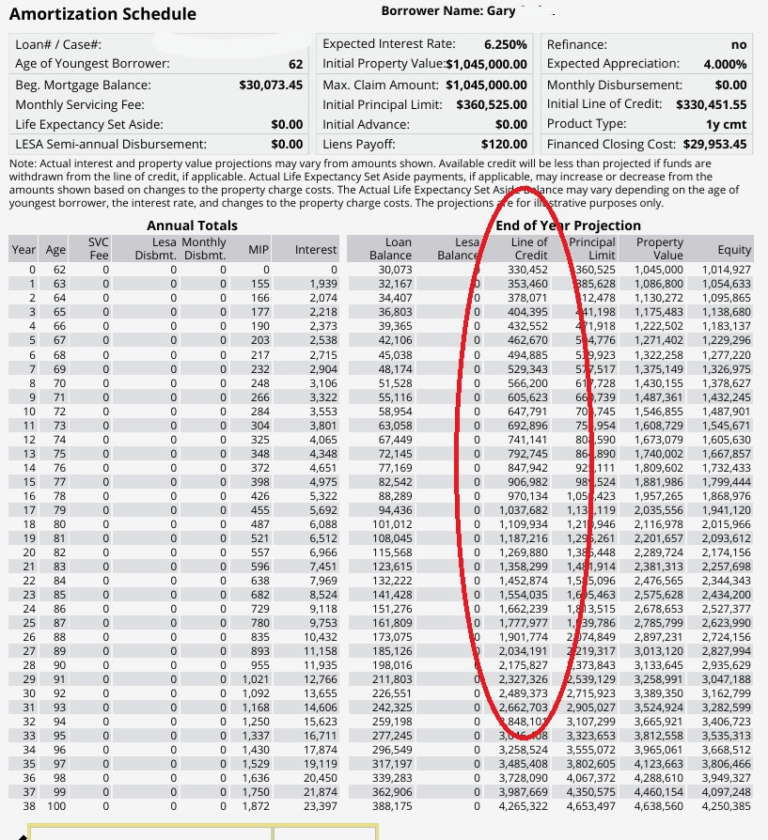
As you can see from the image, Gary’s Line of Credit started at $330,452. In 5 years it will be about $432,552, which is a growth of about $102,000.
In 10 years, we’re at $605,623. Then when he’s 85, Gary’s looking at about $1,554,035.
Now, this is estimated because the growth is based on the interest rate, which adjusts every month. So the true amount might be a little higher or a bit lower.
But this growth is why I’ll always believe that the Reverse Mortgage Line of Credit is the most powerful retirement tool on the market.
Can You Get a HECM Reverse Mortgage
with Bad Credit?
Absolutely! I’ve helped plenty of homeowners over the years who wouldn’t have qualified for a traditional mortgage because of their credit history or limited retirement income.
But FHA doesn’t completely ignore your finances. The lender still needs to make sure you can afford your property taxes, homeowners insurance, and other expenses that come with owning a home.
And here’s where a HECM Reverse Mortgage offers a pretty interesting solution.
It’s called a Life Expectancy Set-Aside (LESA). Basically, we reserve a portion of your Reverse Mortgage proceeds to help cover future property taxes and homeowners insurance.
Now, at first, that might sound like a bad thing. After all, you’re trying to get money out of your home, not have some of it set aside.
But think about what this could mean for someone living primarily on Social Security.
We could eliminate their existing monthly mortgage payment AND establish a reserve designed to pay their property taxes and homeowners insurance for the rest of their projected life expectancy.
And the best part? With a fully funded LESA, the loan servicer handles those payments from the reserve.
Imagine the financial relief that could bring. No more worrying every year about coming up with thousands of dollars for property taxes or another painful homeowners insurance renewal.
Especially here in Florida, where insurance premiums seem to have a mind of their own!
Now, the reserve isn’t unlimited. It’s calculated using projected expenses and life expectancy, and if those costs rise faster than anticipated, the funds could eventually run out. You’re still responsible for keeping those bills paid, along with maintaining your home and meeting any HOA obligations.
But for the right senior, a LESA can be a tremendous benefit.
Instead of simply eliminating a mortgage payment, we’re helping address two other major expenses that can put an enormous strain on someone’s retirement.
And remember, not everyone needs a LESA. It’s simply another tool that can help certain homeowners qualify for a HECM Reverse Mortgage while providing some additional financial security.
What are the HECM Reverse Mortgage Closing Costs?
Let’s talk about something nobody particularly enjoys: closing costs.
One of the biggest complaints I hear about reverse mortgages is that they’re expensive. And yes, a HECM can have higher upfront costs than some traditional mortgages, largely because of FHA mortgage insurance.
But here’s something a lot of homeowners don’t realize. Most HECM closing costs can be financed into the loan, meaning you typically don’t have to write a big check at closing. Of course, financing those expenses reduces the equity available to you.
FHA Mortgage Insurance Premium
The largest expense is often FHA’s upfront mortgage insurance premium, which is currently 2% of the home’s value, up to the applicable FHA lending limit of $1,249,125 in 2026. That insurance helps provide some pretty valuable protections, including the fact that a HECM is a non-recourse loan. Neither you nor your heirs can be held personally responsible for a shortfall if the home sells for less than the loan balance, provided the loan is handled according to FHA’s rules.
Then there are the more familiar mortgage expenses: lender origination fees, appraisal, title insurance, settlement charges, and the required reverse mortgage counseling.
Are there costs involved? Absolutely. But I’ve seen what eliminating a mortgage payment or establishing a line of credit can do for someone’s retirement. The question isn’t simply what the loan costs. It’s whether the benefits justify those expenses for your particular situation.
If you’d like a complete breakdown, including actual fee examples and how HECM costs compare with jumbo and second reverse mortgages, read our Reverse Mortgage Closing Costs Explained article.
You've Spent Your Life Building Wealth. When Do You Get to Enjoy It?
Here’s something I’ve thought about quite a bit over the years.
We spend our entire working lives trying to build wealth. Along the way, we make mortgage payments, contribute to retirement accounts, save what we can, and hopefully watch the value of our homes increase.
And what’s the reward for all that hard work?
For far too many retirees, it’s worrying about whether they’ll have enough money to make it through the rest of their lives.
In fact, a 2026 study from Allianz Life found that 67% of Americans are more worried about running out of money than they are about dying. Even among baby boomers, that number was 59%.
Think about that for a second. More people are worried about outliving their money than they are about death itself.
And after helping hundreds of seniors with reverse mortgages since 2008, I can tell you that I understand why.
I’ve spoken with homeowners sitting on hundreds of thousands of dollars in equity who are afraid to turn on the air conditioning because they’re worried about the electric bill. Others have retirement savings but are terrified to spend them, wondering whether they’ll need that money for medical expenses or long-term care someday.
And then there are the people who have worked hard their entire lives, paid off their homes, and still feel guilty spending money on a vacation or taking their grandchildren somewhere special.
That bothers me.
What good is building all that wealth if you’re too worried about the future to enjoy any of it today?
Now, I’m certainly not suggesting that everyone should run out, get a reverse mortgage, and start spending money like they just won the lottery. That’s ridiculous. Retirement planning still requires discipline, and home equity is a valuable asset that deserves careful consideration.
But I do believe more seniors should understand that their house can be part of their retirement plan.
Maybe a HECM Reverse Mortgage eliminates a mortgage payment that’s eating up half your Social Security check. Perhaps a line of credit gives you access to funds during a market downturn so you don’t have to sell investments at the worst possible time. Or maybe it simply provides some additional financial breathing room to enjoy the years you’ve worked so hard to reach.
And sometimes the benefit isn’t about buying anything at all.
It’s about sleeping better at night.
I’ve seen what happens when someone who’s been worrying about money for years suddenly realizes they have options. The relief is real. Their families feel it, too. Remember Dave’s situation from earlier in the article.
A Reverse Mortgage isn’t going to solve every financial problem, and it certainly isn’t right for everyone. You’re borrowing against your home, interest accumulates, and the decisions you make today can affect the equity available to you and your heirs tomorrow.
But I’ve never believed that the goal of retirement should be to die with the biggest possible bank account while spending your final years worrying about every dollar.
You’ve spent decades building your retirement. Now, you deserve the opportunity to actually enjoy it.
And if a HECM Reverse Mortgage can help you do that responsibly, I think it’s a conversation worth having.
What Happens to a HECM Reverse Mortgage
When You Die, Sell or Move?
One of the biggest misconceptions about reverse mortgages is that the bank takes your house when you die.
I’ve been hearing that one since 2008, and I still have no idea how it became so popular!
The bank doesn’t own your home. You do. And just like any other mortgage, your heirs can inherit the property, subject to the outstanding loan balance.
A HECM Reverse Mortgage becomes due when the last borrower dies, permanently moves out, sells the property, or another event occurs that requires repayment under FHA’s rules. There are also special protections for certain eligible non-borrowing spouses, which can allow them to remain in the home after the borrowing spouse passes away.
So what happens when the loan comes due?
Let’s say your home is worth $500,000 and your reverse mortgage balance is $250,000. Your family can sell the property, pay off the mortgage, and keep the remaining equity after selling expenses.
Or, if your children want to keep the house, they can pay off the reverse mortgage using their own funds or obtain a new mortgage to refinance the balance.
But here’s something I particularly love about Reverse Mortgages.
They’re non-recourse loans.
That means neither you nor your heirs are personally responsible for a shortfall if the loan balance ever exceeds the home’s value.
And if your heirs want to keep the property when the balance is higher than its appraised value, FHA has another protection. They may be able to satisfy the debt by paying 95% of the home’s current appraised value, even if the mortgage balance is considerably higher.
That’s a pretty significant benefit, especially for someone who lives well into their 90s or beyond.
Now, there are some important responsibilities along the way. You must continue paying property taxes, homeowners insurance, applicable HOA dues, and maintaining the home. Failing to meet those obligations can cause the loan to become due before you ever decide to move or sell.
And when the loan does come due, your heirs need to communicate with the servicer and follow the required timelines. There are provisions for extensions in certain circumstances, but it’s not something the family should ignore for six months and hope it works itself out.
In fact, when you do pass away, HUD generally gives your heirs 6 months to settle the debt, and you can even petition them for up to two 3 month extensions.
Here’s what I always tell seniors and their families: A Reverse Mortgage doesn’t mean you’re giving away your house. You’re using some of the equity you’ve built, and whatever remains after the loan is repaid still belongs to you or your estate.
HECM Reverse Mortgage Frequently Asked Questions
Can I get a HECM Reverse Mortgage if I still owe money on my home?
Absolutely! In fact, a large percentage of the homeowners I help still have an existing mortgage. The HECM pays off that loan at closing, provided there’s enough equity and available proceeds to cover the balance. For many retirees, eliminating that monthly principal and interest payment is the biggest benefit of the entire transaction.
By the way, the vice versa is true too. You can also get a HECM if you don’t have a mortgage on your home.
Do I still own my home with a HECM Reverse Mortgage?
Yes! Your name stays on the title, just as it would with a traditional mortgage. The lender has a lien against the property, but it doesn’t own your house. You can sell whenever you’d like, and you’re responsible for property taxes, homeowners insurance, maintenance, and any applicable HOA dues.
Can I make payments on a HECM Reverse Mortgage?
Of course. There’s no required monthly principal and interest payment as long as you meet the loan obligations, but you’re welcome to make voluntary payments whenever you choose. Some homeowners pay the interest to help control their loan balance, while others prefer to preserve their retirement cash flow.
Does a HECM Reverse Mortgage affect Social Security or Medicare?
No. Money received from a reverse mortgage doesn’t affect your regular Social Security retirement benefits or Medicare eligibility. However, needs-based programs such as Medicaid and Supplemental Security Income (SSI) have different rules, so you’ll want to be careful about how borrowed funds are held and spent if you receive those benefits.
Can I lose my home with a Reverse Mortgage?
Yes, if you fail to meet the loan requirements. A HECM eliminates required monthly principal and interest payments, but you must still pay property taxes, maintain homeowners insurance, keep the home in reasonable condition, and meet occupancy requirements. That’s why we review these obligations carefully before closing.
What happens if my home loses value?
One of the protections I really like about FHA-insured HECMs is that they’re non-recourse loans. If your loan balance eventually exceeds the home’s value, neither you nor your heirs can be held personally responsible for the shortfall, provided the loan is resolved according to FHA’s rules.
Is a HECM Reverse Mortgage a good idea for someone who doesn't need the money?
It certainly can be. Remember Gary’s story earlier? He was financially comfortable, owned his home free and clear, and established a HECM line of credit because he wanted another source of funds available in retirement. He wasn’t looking to spend the money immediately. He wanted flexibility.
Of course, the upfront costs and long-term implications still need to make sense. A reverse mortgage isn’t automatically a good fit simply because you qualify.
I have a question that you didn't answer. What now?
I’m a terrible mind reader…sorry! Feel free to give me a shout at (888) 309 9705, email jason@keyhomelending.com or schedule a time to talk at www.reversequotes.com.
I’ll make sure your exact question gets answered!
Let's See What Your Home Can Do for Your Retirement
I’ve been helping seniors with Reverse Mortgages since 2008, and if there’s one thing I’ve learned, it’s that everyone’s retirement looks a little different.
Some people need to eliminate a mortgage payment that’s eating up their monthly income. Others want to establish a line of credit for future expenses. And some simply want to enjoy the retirement they’ve worked so hard to build without constantly worrying about money.
Whatever your situation, the first step is understanding your options.
I’ll help you figure out how much you may qualify for, explain the costs, and compare the programs that make sense for your circumstances. And if a HECM Reverse Mortgage isn’t the right fit, I’ll tell you that, too.
Ready to see what your home equity could do for you?
Visit ReverseQuotes.com for a personalized Reverse Mortgage estimate. No pressure, no obligation, and no confusing mortgage industry nonsense.